
What Kosciusko County Deed Records Put on Paper
A deed is a written claim that one party conveyed land to another. The Kosciusko County Recorder files deeds alongside mortgages, liens, plats, and easements. That mixture matters. A search hit could be any of those instruments. Read the document type before treating it as proof that title actually transferred.
| Deed Type | What It Does | Common Use |
|---|---|---|
| Warranty deed | Conveys the stated interest with title promises written in the instrument | An ordinary arm's-length transfer |
| Quitclaim deed | Conveys whatever interest the grantor has without the same warranties | Family transfers or correction work |
| Trustee or personal-representative deed | Transfers land through a named fiduciary authority | Trust or estate administration |
| Sheriff's deed | Records a transfer after the required court and sale process | Completed foreclosure-related transfer |
| Tax deed | Records a transfer after the statutory tax-sale process | Completed delinquent-tax proceeding |
Some neighbors in the record books are not deeds at all. A mortgage or lien encumbers property. It does not convey it. A tax-sale list or foreclosure complaint only shows a process in motion, not a finished change of ownership. Title changes later, and timing matters here. The change comes when the court process finishes and the transfer instrument is recorded with the county.
Doxpop Sets the Online Depth for Kosciusko County Deeds
Online depth in Kosciusko County is set by Doxpop, the Recorder's web partner. Its coverage table starts Kosciusko index data in January 1991. Scanned images begin a year later. The gap is easy to misread. A 1991 index entry may carry no image, yet be a fully valid deed. Anything recorded earlier may be equally valid and simply missing from the portal. The county's coverage screen shows that boundary at a glance.
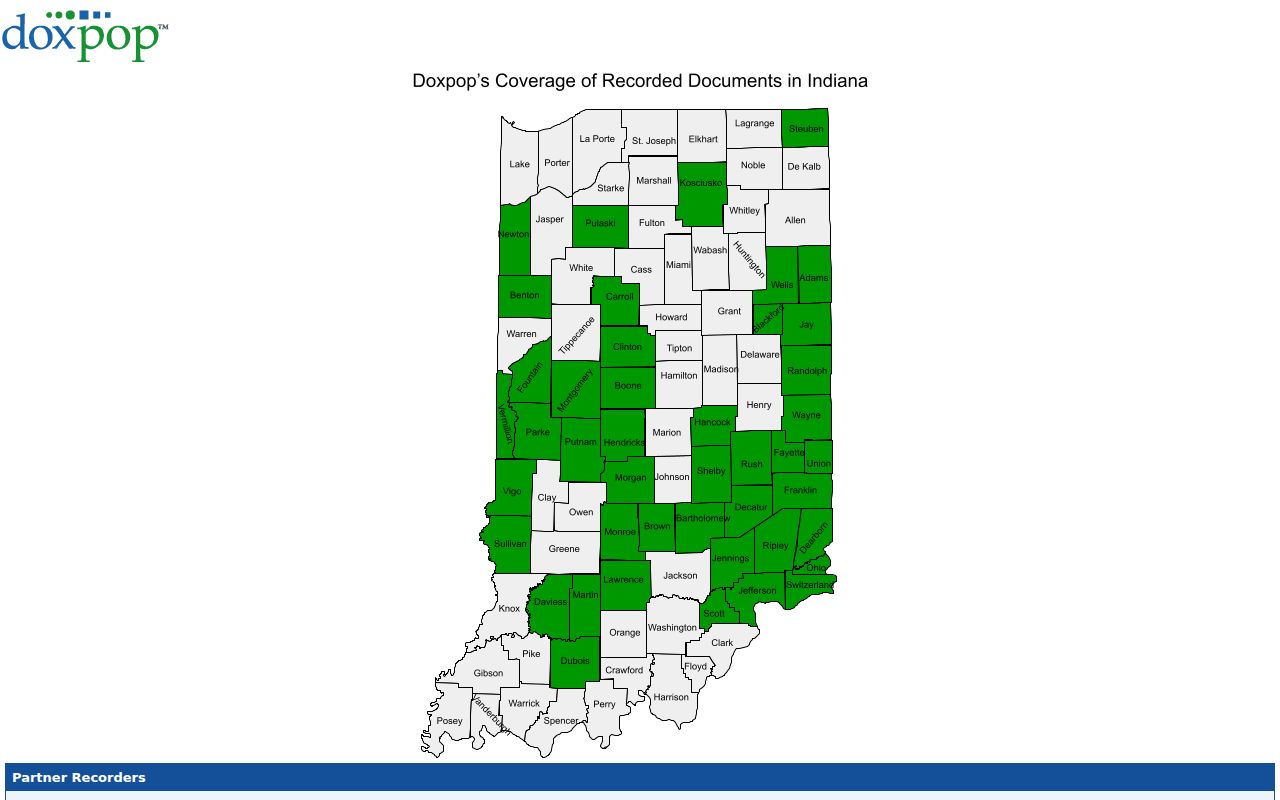
That starting date works as a routing clue. Once a deed falls before it, leave the portal behind and continue in deed books, indexes, or microfilm instead.
Note: An online cutoff marks the portal's reach, not the first year Kosciusko County kept deeds.
Fields That Narrow Kosciusko County Deed Records
Advanced search fields narrow Kosciusko County deed records by grouping queries around three things: the parties, the legal description, and document information. The service documents those fields, and they are the dependable ones. Kosciusko's own document-type menu may not match other counties, so lean on the options the service itself describes.
| Search family | Documented inputs | Use in the deed trail |
|---|---|---|
| Party | Name; exact or partial match | Find grantor and grantee entries despite spelling variants |
| Platted legal description | Subdivision, block, lot | Match a lot-based conveyance |
| Government description | Township, section, range | Narrow rural or unplatted land |
| Document data | Date range, book/page, instrument number | Retrieve or confirm a known filing |
The Doxpop advanced-search page shows the subscription route used for deeper filtering.
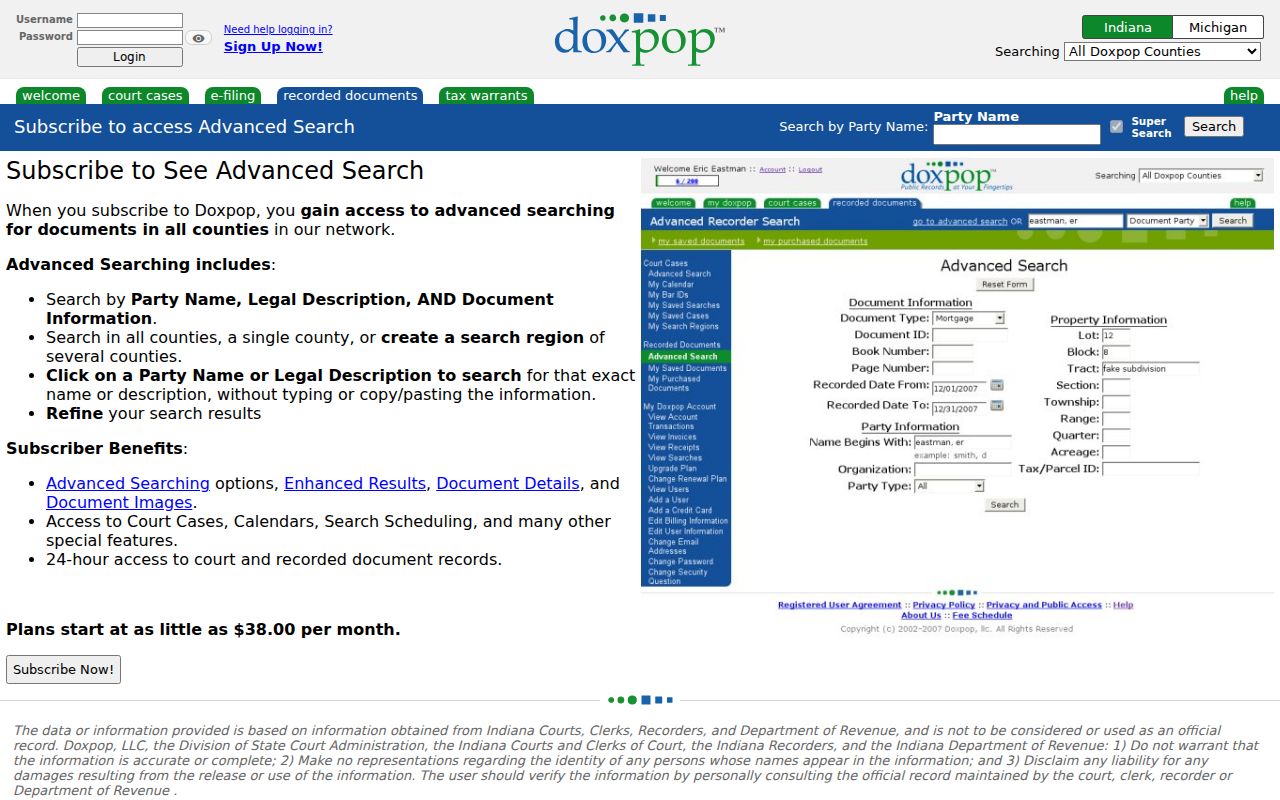
One access split deserves attention. Index, detail, and image access can each carry different limits. When the web stalls, the Recorder's counter and courthouse terminals remain the practical alternative.
Follow Kosciusko County's Grantor-Grantee Trail
Every deed has two roles. The grantor conveys the interest; the grantee receives it. Reading those roles in sequence turns scattered Kosciusko County deed records into one chain of title tied to a single legal description.
- Start with the current owner's likely purchase deed and confirm that party as grantee.
- Record the instrument number, recording date, deed type, legal description, and named grantor.
- Search that grantor as a prior grantee, then match the land description rather than relying on the name alone.
- Repeat until the chain reaches the web cutoff or points to a book and page that must be retrieved offline.
- Grantor
- The party conveying the interest stated in an instrument.
- Grantee
- The party receiving that stated interest.
- Chain of title
- The linked sequence of transfers affecting the same land.
- Book/page
- A volume and page reference used to retrieve an older recorded document.
- Instrument number
- A filing identifier used to locate a particular modern record.
Legal Descriptions Keep Kosciusko County Deeds on the Same Land
A matching surname proves little on its own. Compare the subdivision, block, and lot details on every instrument. You can also check the township, section, and range description. A shift from metes-and-bounds text to a platted lot often marks a new subdivision. A change in acreage can signal a parcel split or combination. Treat these as checkpoints, not errors. The Auditor keeps plats, transfer lists, split and combination records, annexations, and related county material. When deed text stops lining up, ask that office for help. It can connect the predecessor and successor parcels.
Earlier Kosciusko County Deed Books Survive Beyond the Web
Historic Kosciusko County deed research runs unusually deep. The Indiana Archives catalog lists a Recorder deed record and index series. It covers 1839 through 1902 on ten reels. The Indiana State Library's microfilm inventory reaches even wider. It runs from 1836 through 1934, with grantor-grantee indexes, tax-title deeds, sheriff deeds, plats, and land books. That offline chain can answer a nineteenth-century ownership question no portal can touch. Start from the last known book, page, party, or date. Then request the specific reel or volume rather than casting a broad surname net.
Request a Kosciusko County Deed Copy
Start with the online image if one exists. Otherwise, contact the Kosciusko County Recorder with the instrument number or book and page, the recording date, the parties, and the copy type wanted. Counter and mail orders cover what the subscription portal skips. The office sits at 100 W Center Street, Room 203, Warsaw, and accepts documents before 4 p.m. during posted hours of 8:00 a.m. to 4:30 p.m.
A county fee PDF effective in 2017 priced copies through 11 by 17 inches at $1 per page, larger copies at $5 per page, and certification at $5, with a self-addressed stamped envelope requested. That schedule is historical. Confirm current charges and mail instructions before sending payment.
Recorded does not mean guaranteed. The index shows what reached the Recorder; it is not a title opinion and cannot rule out unrecorded interests.
When Kosciusko County Deed Records Point to Court
Sometimes the deed only tells half the story. Probate, foreclosure, quiet-title, partition, and judgment files explain why a later deed exists at all. Indiana MyCase shows the case trail. The public docket may lack the needed order. In that case, get an official court record from the Kosciusko County Clerk. Remember that a complaint or sale notice is just one stage. Confirm the judgment or order. Also confirm the later recorded deed before calling it a completed change in title.
An Index Hit Is Not the Full Kosciusko County Deed
An index row is a pointer, not the deed. Kosciusko County property records will match on a name or legal description and give you a retrieval handle. Copy down the instrument number, recording date, document type, grantor, grantee, execution date, and any book, page, or image reference. Note the legal-description fields too.
Then open the image itself. The full instrument can carry easements, reservations, exceptions, acreage, prior references, signatures, acknowledgments, and a richer land description than any result row shows. Check whether the portal lets you view, download, or print the image, or only displays an index notice.
Be careful with name-only hits. They can point to a different parcel entirely. A legal-description match under a former owner, though, may still be a valid historical transfer or a released encumbrance. Only the complete deed supplies the context to tell those situations apart.
Property Watch Adds a Timely Kosciusko County Deed Alert
Kosciusko County council and commission materials from 2024 and 2025 mention CSI, Equity Protect, and a free Doxpop Property Watch program. Each service flags new record activity. The activity is tied to the information you enroll. None of them blocks a filing. None replaces reading the actual instrument.
When an alert arrives, compare the details against what you know. Check the named party, parcel or legal description, document type, and recording reference. Something unfamiliar? Contact the Recorder through the official county page and keep the notice. A fraud alert is an early-warning tool. It is not a certified title search or a ruling that a filing is false.
Electronic Filing Feeds Kosciusko County Deed Records
The Recorder lists Simplifile, ePN, and CSC as electronic-recording providers. E-filing changes how a deed arrives, not what happens next. Kosciusko County deed records still depend on acceptance, indexing, and a solid recording reference. A document handed to a vendor is not proof the county recorded it.
For research, trust the final instrument number and recording date over any upload receipt. A filing can be rejected or go missing. Work through the submitting party in that case. Use the Recorder's current process too. The county's historical fee sheet warns users not to call about rejected documents. Follow live office instructions and provider status rather than the old PDF alone.