
Kosciusko County Owners Through Time
A reverse chain moves one recorded deed at a time. The Kosciusko Recorder index on Doxpop covers the recent end online. Older owners require other stops. Recorder books carry the deeper record. Indiana Archives and Records Administration finding aids also help. Indiana State Library microfilm holds copies as well. Plats and survey records help when one old tract became several modern lots.
| Transfer source | Documented span | Access point | Clue preserved |
|---|---|---|---|
| Doxpop Recorder index | Index from January 1991; images from January 1992 | Online or Recorder office | Parties, dates, document references, and legal-description clues |
| Deed books and grantor/grantee indexes | Runs beginning in 1834/1836 | Recorder, IARA, State Library microfilm | Earlier conveyances, book/page links, and full descriptions |
| Sheriff and tax-title deed series | Sheriff deeds 1870-1925; tax-title deeds 1862-1903 | Microfilm finding aid and archive request | Transfers that may not resemble a routine sale |
| Plats, survey books, and maps | Historic and modern series | Auditor, Surveyor, Recorder, and State Library | Lot identity, splits, replats, streets, and tract context |
The date behind your question picks the starting source. Recent transfers begin online. Once a chain reaches the 1991 cutoff, carry the last book/page or prior-instrument clue to the office or archive. A name alone proves little, since every link must carry the same parcel, lot, or tract description forward.
Kosciusko County Prior Owner Start
Find the most recent recorded conveyance first. Beacon may show the current administrative owner and parcel number, but the recorded deed supplies the grantee, grantor, recording date, instrument reference, and a fuller land description. The recorded deed does more. If the public parcel card looks stale after a sale, the county says the Auditor keeps the most current ownership and transfer records. Give that office the parcel ID, recording date, and instrument number.
The newest grantee anchors the reverse chain. That instrument's grantor is usually the next prior owner. A quitclaim, fiduciary, tax, or sheriff deed may need another source before the sequence makes sense. Keep the instrument type as it stands. Not every transfer is a sale.
Note: Mailing and property addresses are separate facts, so match land descriptions before treating a same-name result as the same owner.
Kosciusko County Former Owner Depth
The Doxpop coverage date is the main online limit for former owners. Kosciusko County index entries begin in January 1991. Scanned images begin in January 1992. An entry from the first year may be index-only. Paid advanced features and image access can differ from a basic search, while the Recorder office or a public courthouse terminal may offer another route.
The Doxpop county coverage page states that cutoff plainly. Checking it saves effort before a long chain begins.
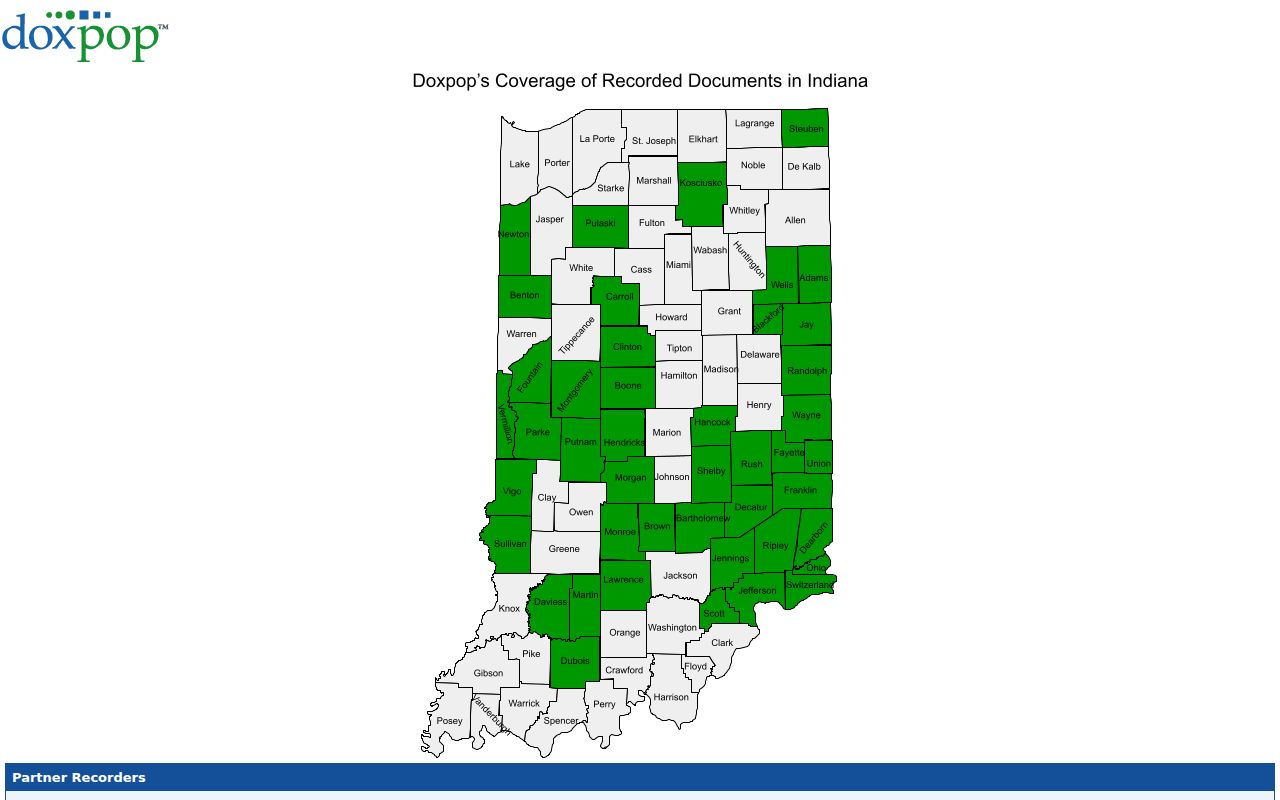
If a transfer falls before the online span, write down its book/page and party names. Those clues carry you from the web index to the paper or microfilm version.
Online cutoff. Doxpop reaches January 1991 for index data and January 1992 for images; earlier owners require books, microfilm, or archives.
Reconstruct Kosciusko County Prior Owners
Stick to a fixed order. Skip the surname fishing. Each former owner must connect to the same legal parcel and to the instrument by which that person acquired it.
- Use the parcel number, current grantee, and legal-description clues to locate the latest deed. Save its instrument number and recording date.
- Read the grantor on that deed. Compare the full description, acreage, lot and block, exceptions, and any cited prior instrument.
- Search that grantor as an earlier grantee. Try spelling variants, initials, estate names, trust names, and entity names when needed.
- Repeat the match. At the online cutoff, move the last reliable book/page reference into the reverse index, deed book, or microfilm series.
- Grantor
- The party conveying an interest in the recorded instrument.
- Grantee
- The party receiving the interest named by the instrument.
- Chain of title
- The linked sequence of instruments affecting ownership through time.
- Reverse index
- An index organized to help search the grantor side of past conveyances.
- Warranty and quitclaim deeds
- Different conveyance forms; the label alone does not settle the quality of title.
Kosciusko County Owner Chain Breaks
A chain often appears to break because the land changed rather than the records failing. The Kosciusko County Auditor handles deeds and affidavits. It also handles sales disclosures, plats, splits, combinations, annexations, and street-name records. A parent tract can become several successor parcel IDs. A replat may replace old lot references. Annexation can shift city authority while the land records stay in the county.
Compare the deed's full legal description with the modern parcel card. Keep leading zeroes, hyphens, and decimals in parcel numbers. Do not decode each segment without an official county key. When a successor parcel hides under a new number, search the prior surname. The county FAQ recommends a last-name search. It applies to bills changed by a split or combination in the prior two years. That trick finds many missing links.
Note: A parcel number is an administrative key, while the deed and recorded plat carry the land description that connects former owners.
Kosciusko County Estate Owners
Some previous owners vanish from the buyer-and-seller pattern because death or court action drove the transfer. Search Indiana MyCase and the Kosciusko County Clerk by the decedent, the phrase “Estate of,” a fiduciary, or a known case number. A probate docket may show a petition, appointment, sale order, or final account. It does not replace the deed.
Then return to Doxpop. Look there for an executor, administrator, personal representative, sheriff, tax-title, or later private deed. The court order explains authority. The deed places the transfer in the county record. Older estates need more. The State Library guide and microfilm inventory cover probate, wills, guardianship, and estate material. Two sources together can restore a missing link without guessing who inherited the parcel.
Historic Kosciusko County Former Owners
Kosciusko County dates to 1835. Its paper trail of deeds reaches nearly that far back. Researchers can reach official deed records and indexes from 1839 through 1902 on ten reels. The route is the IARA Kosciusko Recorder series. The State Library's microfilm guide offers even more detail. It lists deed material from volume A/1 beginning in 1836. Its grantor/grantee index runs start in the 1830s.
Treat that archive as a working tool, not a list of names. Work backward from the last known reference. Pick the right index and date span. Find the party entry, and then pull the cited volume and page. Copy the execution and recording dates, both parties, any consideration shown, the full legal description, exceptions, and marginal references. Keep perspective on size. A nineteenth-century deed may describe a farm tract far larger than today's parcel.
Kosciusko County Plats Preserve Ownership
Plats and maps can show that two differently worded transfers concern the same ground. The State Library catalog holds the 1914 county atlas. It also holds twentieth-century farm plat books. A 1999 Wawasee and Syracuse lakes map sits in the catalog too, alongside county plat maps dated 1999, 2003, 2010, and 2012. County Surveyor resources add more depth. Government corners, original field notes, legal survey books, and government-lot material all sit there.
Maps give context, not proof. A subdivision name carries a lot and block. That detail can bridge the deed index to a current parcel. Historic aerials may show when a road, lake edge, drain, or development pattern shifted. Still, neither a mapped owner label nor a GIS polygon settles title. For a disputed chain, the recorded plat, survey, and deed remain the stronger evidence.
Inspect Each Kosciusko Index Hit
A Doxpop result is only an index abstraction until someone reads the underlying document. Note the instrument number and document type. Also note the recording date, all party roles, the book/page or image reference, and legal-description fields. Then inspect the image where access allows. An advanced-search screen may offer extra field families or subscription access. Check its current options and prices live. The Doxpop advanced search source shows the line between basic discovery and expanded access.
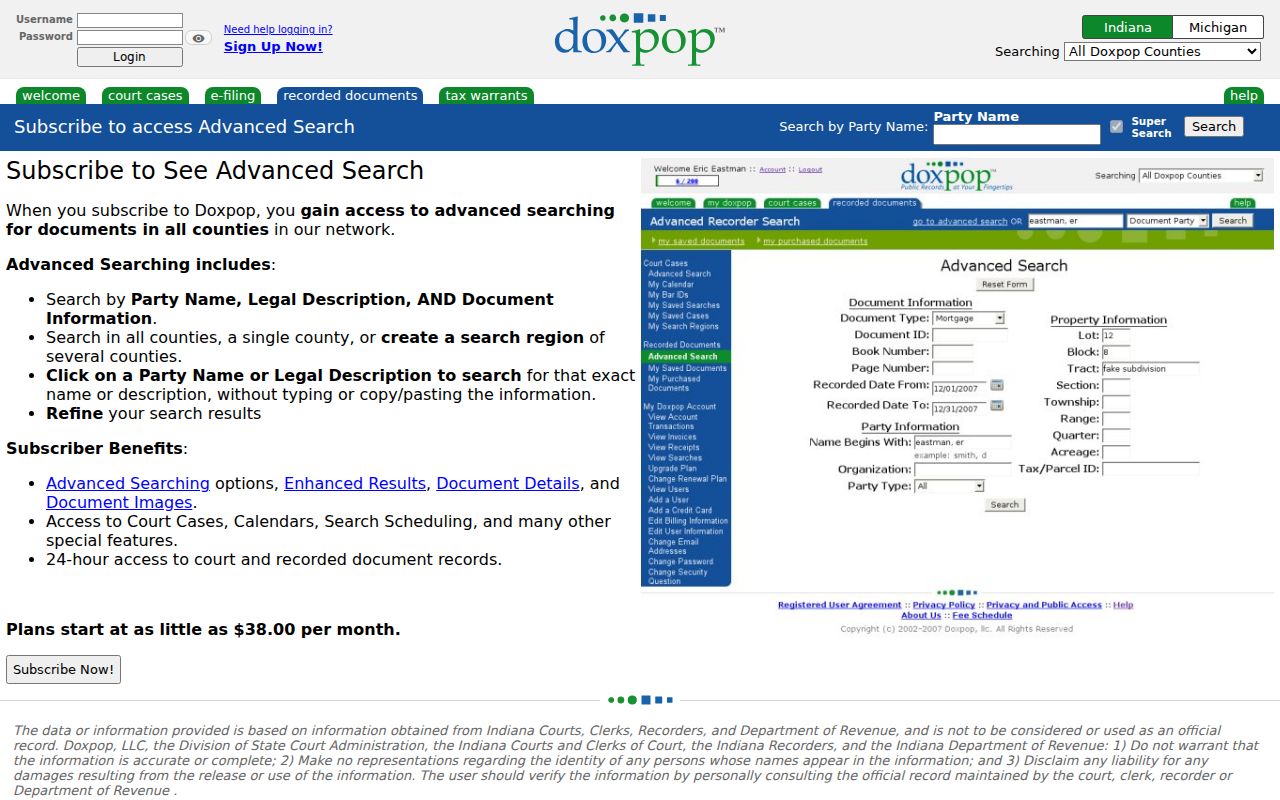
The screen drives home a core rule of deed research. An index hit only starts the comparison. It does not prove the legal description matches the subject parcel.
Kosciusko Ownership's Documented Reach
Kosciusko County's documented trail reaches back to its founding era. Doxpop covers recent decades. IARA identifies an 1839-1902 Recorder series. The State Library inventory lists deed and index runs from 1834/1836 onward. That same inventory flags sheriff deeds, tax-title deeds, cemetery deeds, swamp-land deeds, plats, and other instrument groups. These instrument groups can explain an odd link in the chain.
No official source documents a Kosciusko courthouse fire or a destroyed decade. So resist inventing such a story to explain a hard search. Gaps usually close by switching repositories or testing name forms. Other fixes include following book/page references. You can also check whether a tract was split, combined, or replatted. When a single instrument must be ordered, the dedicated Kosciusko County deed records page covers copy and recording mechanics.
Lawful use. Trace former owners for house history, estate work, or property diligence. Never use public names or addresses to stalk, harass, or harm someone.